
The Founder's cheat sheet to SR&ED
9 SR&ED Tips You Can't Afford to Miss

1. Salary vs Dividends
Are you a co-founder who is technical? Are you involved in the technical development efforts?
Whether you are coding hands-on or supervising, and reviewing work done, your time spent could be eligible for SR&ED.
Don't pay yourself in dividends - you cannot claim it. Consider drawing a salary instead if you are also technical!
2. Hire Local
Make strategic hiring decisions. For staff that will engage in SR&ED eligible work, hire local.
i.e., hire Canadian tax residents. Anyone else will not be eligible. Use SR&ED to offset their potentially higher salaries.
Draw from remote candidates or contractors for other non-SR&ED eligible areas like
- UX & Design
- Marketing
- Market researchers
- Sales
For SR&ED eligible work, hire Canadian tax residents or Canadian corps (sub-contractors)
3. Salary > Contract Payment
Assume Alice works at your business and does SR&ED eligible research.
Alice is a contractor in Ontario whom you pay $100K.
If you hired Alice as an employee instead, your SR&ED refund increases by 48%
You get a bigger bang for your buck!
If you want to maximize your refund (who doesn't!), have employees conduct SR&ED eligible work
4. Use a Project Management tool
Yes, even a free one! The marketplace for these tools is overflowing with choice!
My recommendation:
0-150 employees: Use Linear (minimalist, distraction-free) or Clickup (full-featured, very customizable)
Fallback choice: Use Google Sheets (since you are likely on Google Workspace anyway). It’s excel on the cloud, so expect limitations like lack of structure and minimal image support.
All work items (especially SR&ED ones) should have a matching task in this tool.
Make task descriptions non-cryptic.
Example of a bad one: “Fixed the blue widget”
Example of a good one: “Fixed the blue widget by switching to Adam optimizer and decreasing learning rate for fine-tuning model”
Use a project management tool to track all your work!
5. Document2Go
Don’t rely on memory for innovative nuggets you worked on 1 year ago.
You might only remember 1/2 of it. That’s $$ lost!
Add a quick ‘sred’ label to the story!
Here’s a quick example on Linear.
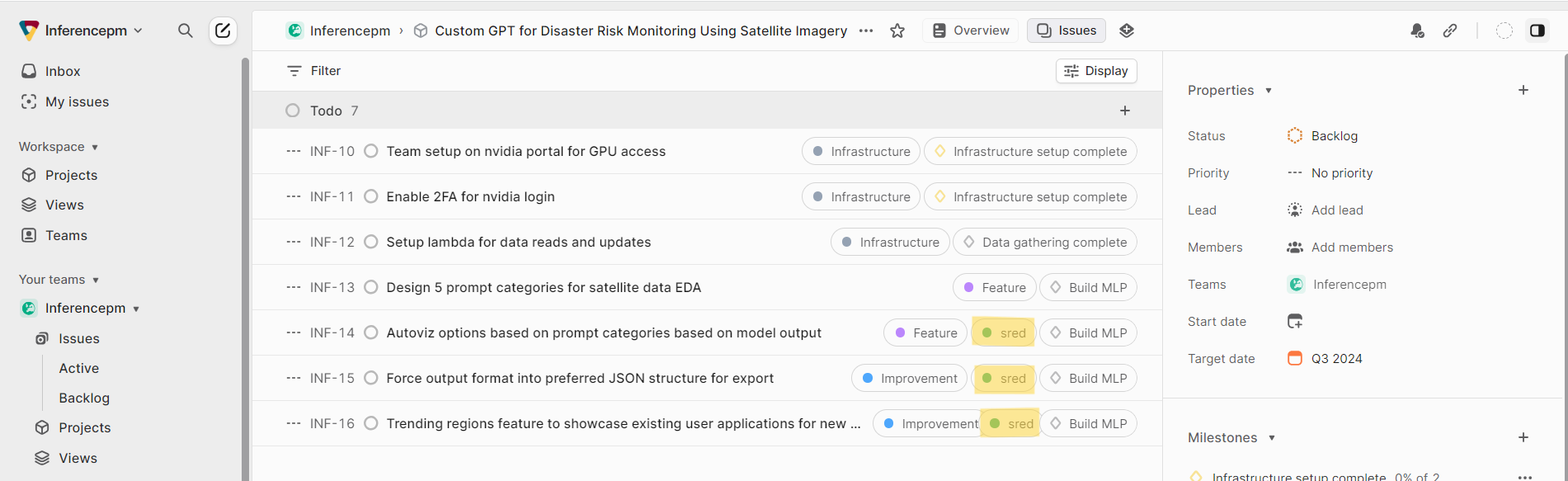
This will save you many many hours of effort at year’s end.
Plus, you minimize risk of leaving some SR&ED activities out.
Remember, more time spent on SR&ED = more $$ back in your company’s bank account.
Tag and label potential SR&ED activities during Sprint planning
6. Ensure traceability to your code
This might be an obvious one for development teams - but for completeness….
When you commit code, establish a norm for commit comments.
Ensure that they tie back to a work task, for example:
[COOLPROJ-123] Here’s a super descriptive comment on what i changed and why
Your project management tool (see #4) will auto sync the comments. All your documentation in one centralized location!
Here are two primers I recommend using:
How to write better Git commit messages by Natalie Pina
Writing a Good Git Commit Message - GitKraken
Or even better yet - if you already use Claude Code, Codex, or another AI coding tool - ask it to generate descriptive code commit messages and descriptions, with specific emphasis on experimental development work.
Link Github to your project management tool & write descriptive code commit messages!
7. Don’t forget about non-coding activities
These could also be eligible for SR&ED!
A few examples:
- Brainstorming a new architectural approach with your technical PM?
- Workshopping a debug session on a feature that has SR&ED eligible work?
- Working on a new approach to optimize a workflow?
- Sketching out architecture diagrams or software design documents?
Awesome! this is your SR&ED lead in. Follow these steps:
- Grab a whiteboard or notebook picture - wherever you scribbled thoughts down
- Create a work task in your project management tool (see #4)
- Attach the image to this task
- If you think this might be eligible for SR&ED, tag it (see #5)
It isn’t only developers and engineers who perform SR&ED eligible work
8. Use Slack or Teams?
Use any of these for work discussions: Slack, Teams, WhatsApp, email?
Have multiple channels for themed discussions?
Don’t delete your history!
These are great for record keeping and a ready reference for all the fantastic brainstorming and iterations that your team did.
Chat and email history can be great sources of ad-hoc brainstorming evidence.
9. Do you pay contractors who are involved in your R&D?
Ask for and store their invoices.
This serves as proof of their engagement with you.
Their invoices should contain descriptions of the work they performed.
The simplest way to maintain this is via your accounting software e.g., QBO. When your contractor raises an invoice to you - simply attach it to the transaction that captures your payment of their invoice.
Bonus #10. SR&ED 👌🏼 Failed experiments
You had an innovative-as-heck idea, spent time and experimented on it….
But it failed...
You can still claim SR&ED on it!
Make sure you follow the documentation best-practices laid out above.
And reclaim $$ on time spent in experimentation - successful or otherwise!
Even failed experiments can be eligible for SR&ED refund.
Ready to maximize your SR&ED refund? Experience the difference with our Engineering-first SR&ED claim!