Understanding SR&ED science and research codes
Learn to classify your R&D projects correctly to satisfy both the CRA and Statistics Canada
.jpeg)
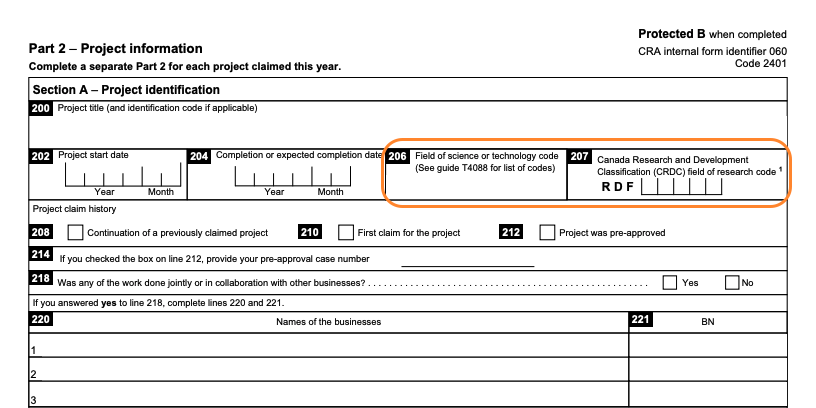
While line 206 (CRA Field of science/technology code) helps the CRA technically assess your project, the new line 207 (Field of research/RDF code) allows Statistics Canada to map the national R&D landscape.
Getting both right ensures your claim is professional and administratively complete!
For any business leader overseeing a Scientific Research and Experimental Development (SR&ED) claim, the T661 form is the primary vehicle for recovering R&D costs. While technical narratives (the "How" and "Why") are the core of a claim, two administrative fields in Part 2 are essential for proper filing: Field of science or technology code (line 206) and the newly introduced Canada Research and DevelopmentClassification (CRDC) field of research code (line 207).
The Dual Coding System
Historically, claimants only navigated Field of science or technology code (line 206). However, following the Bill C-15 reforms that received Royal Assent in March 2026, a second mandatory classification is now required for taxation years beginning after December 15, 2024.
- Line 206 (Field of science/technology code): This is the CRA’s internal mapping tool. It helps them technically categorize your work (e.g., 1.02.01 for software) so they can assign a specialized Research and Technology Advisor (RTA) to review your file and publish annual program statistics.
- Line 207 (Field of research/RDF code): This new requirement uses a five-digit code from the Canada Research and Development Classification (CRDC) 2020 system. This data is specifically for Statistics Canada to track where innovation is occurring across the country.
Mapping the 2026 R&D Landscape
The government uses these codes to generate annual program statistics that reflect the health of Canadian innovation. According to the 2025-26 fiscal data, the impact is significant:
- Total program funding: The CRA allowed $4.6 billion in Investment Tax Credits (ITCs).
- Claim volume: 23,677 claims were filed by Canadian businesses.
- Software dominance: Software Development remains the largest single field, accounting for 42.6% of all allowed credits.
Key Filing Tip: Advancement over Industry
A common mistake is selecting a code that matches your company's industry rather than the field of the advancement. If your food-processing company develops a novel machine-learning algorithm to predict supply chain disruptions, your codes for both Line 206 and 207 should reflect Computer Science/Software Engineering, not Food Science.
FAQ: Navigating SR&ED Classifications
1. What is the difference between Line 206 and Line 207?
Line 206 is used by the CRA to technically categorize your project for assessment purposes. Line 207 is a new requirement (Bill C-15) that provides granular data to Statistics Canada using the CRDC RDF coding system.
2. How do I choose the codes for a Software Development project?
Choosing your codes is a three-step process focused on the technical nature of your work rather than your business sector:
- Identify the technical advancement and uncertainty your team attempted to resolve.
- Select Line 206 (CRA): Consult the CRA’s list of Field of Science/Technology codes. Choose the code that represents the specialized expertise a reviewer would need to evaluate your work (e.g., a software expert vs. a mechanical engineer).
- Select Line 207 (StatCan): Consult the CRDC 2020 Version 2.0 list. Find the code that best describes the primary field of research and enter the first five digits (e.g., RDF102)
Here are two hypothetical examples:
SR&ED project focus: Developing a decentralized inference engine to run AI predictions on low-power edge devices with a target latency of under 100ms
Line 206 (Field of science/technology code): 2.02.09 – Software engineering and technology
Line 207 (Field of research/RDF code): RDF10203 (Programming languages and software engineering)
SR&ED project focus: Engineering a novel indexing structure for real-time spatial-temporal data to achieve sub-ms query performance on billion-point datasets
Line 206 (Field of science/technology code): 2.02.09 – Software engineering and technology
Line 207 (Field of research/RDF code): RDF10206 – Information systems
3. Where can I find the full list of codes for Line 206 and Line 207?
Because these lines report to different government agencies, you must consult two separate classification systems:
- For Line 206 (CRA Technology Codes): You can find the traditional Field of Science or Technology codes in the CRA’s T4088 Guide, specifically in the classification table found here.
- For Line 207 (StatCan RDF Codes): You must use the Canadian Research and Development Classification (CRDC) 2020 Version 2.0. The full list of Field of Research (FOR) codes begins on page 18 of this official PDF. You can also find them on this navigable webpage.
Pro Tip: When filling out Line 207, the CRA instructions specify that you should only enter the first five digits following the "RDF" prefix (e.g., RDF10203). Note that the code you select for your project can differ from the field of science in which you carry out your regular business, as it must reflect the nature of the advancement itself.
4. Does my project need to be "successful" to qualify for these codes?
No. SR&ED eligibility is based on the systematic investigation into a technological uncertainty. A failed experiment or a project that produced no commercial result still qualifies, provided you followed a scientific approach and gained new technical knowledge from the failure.
5. Can a "wrong" code trigger an audit?
While an inaccurate code is rarely a standalone trigger, skipping required fields or providing information that wildly contradicts your technical narrative can increase your probability of audit selection. "Unclear project boundaries" and "narrative flaws" are risk factors that you can control - don't miss filling out these two fields.
5. Are there best practices you can implement TODAY that remain evergreen?
Absolutely! Check out our Founder's cheat sheet to SR&ED.